


Inside a Multi-Location Dealership EV Rollout

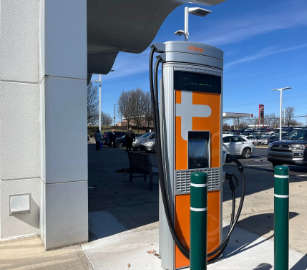
Before starting Eagle 1 Solutions, Steve Sanchez personally worked on one of the more complex EV charging rollouts in Orange County: 15 ChargePoint stations, split between Level 2 and Level 3, across three Wilson Automotive Group dealership locations. That project was completed under a different company, not under the Eagle 1 Solutions name, and that distinction is worth stating plainly rather than blurring.
What made the project hard wasn’t the chargers themselves, it was everything around them, coordinating with city officials, working directly with the utility, and securing permits across three separate sites at once. That same kind of coordination is exactly what full turnkey installation is built to handle today. Here’s what that project actually involved, and why it still shapes how projects get handled now.
Three Locations, One Coordinated Rollout
A single-site charger installation is a fairly contained project: one property, one electrical service, one permit process, one timeline to track. A three-location dealership rollout multiplies every one of those variables at once. Each site has its own electrical capacity, its own city jurisdiction, and its own permit timeline, and none of those three processes naturally run in parallel on their own, somebody has to actively keep them moving together. That coordination work, more than the physical installation, is usually what determines whether a multi-site project stays on schedule or drags out for months.
Splitting Chargers Between Level 2 and Level 3
An auto dealership isn’t a single-use lot, vehicles sit for very different lengths of time depending on why they’re there. Inventory and customer service bays tend to favor Level 2, where a vehicle can charge over several hours without tying up higher-cost equipment. Test drives and quicker turnarounds favor Level 3, where speed matters more than cost per charger. The 15-charger total on this project split roughly two-to-one in that direction, more Level 2 than Level 3, which tends to be the norm for a property with more long-dwell spaces than fast-turnaround ones.
Permits and Utility Coordination Across Multiple Sites
The hardest part of this kind of project rarely shows up in the finished result. Every one of the three sites needed its own permit approval and its own coordination with the utility to confirm the electrical service could actually support the new load, before a single charger went in the ground. None of that is visible in a photo of a finished charging station, but it’s usually the majority of the actual project timeline, and it’s the part that a full turnkey approach is specifically built to absorb on a property owner’s behalf.
What the Finished Stations Actually Look Like
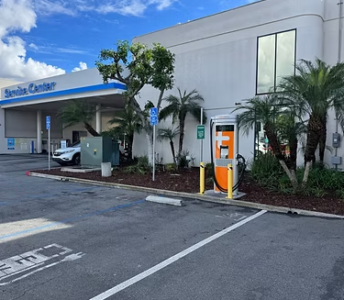
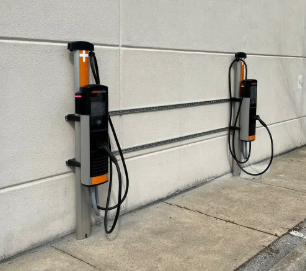
The real photos from this project show stations placed right where dealership traffic actually moves, next to service center entrances and near the showroom front, not tucked into an overflow corner of the lot. That placement wasn’t incidental. A charger nobody walks past doesn’t get used, and a dealership property has a specific rhythm to where people and vehicles actually sit, service bay, showroom, test drive lane, that the charger layout has to match rather than fight.
Manufacturer-Preferred Installer Networks, and a Different Approach
This particular project came together through a common industry pattern: a manufacturer selects equipment first, then refers the property to its own network of preferred installers to handle the work. That model works, and it’s exactly how this rollout was staffed. It also means the property owner is choosing an installer relationship on the manufacturer’s terms, after the equipment decision is already made, rather than the other way around.
Eagle 1 Solutions runs differently on this specific point: equipment gets sold directly at distribution pricing across several manufacturers, including ABB, Siemens, EVBox, Blink, and Tesla, so a property owner isn’t locked into one brand’s installer network before anyone has assessed what the property actually needs.
What to Ask Before Starting a Multi-Location Project
Anyone evaluating a similar rollout today is really deciding one thing before anything else: who owns the coordination across every site, start to finish. A few questions surface that quickly. Is one team handling permits at every location, or is that falling back on the property owner site by site? Is utility coordination bundled into the project, or a separate call the owner has to make themselves? Does the Level 2 to Level 3 split get decided per location based on how that specific site is actually used, or applied as one uniform ratio across the whole portfolio?
None of those questions have a universal right answer, but a property owner who gets clear answers before signing anything avoids most of what makes a multi-site rollout drag out. It’s also worth asking how a delay at one location gets handled, whether the other sites proceed on schedule regardless or the whole project waits on the slowest permit, since that single detail tends to matter more in practice than anything written into the original proposal.
Why Steve Built Eagle 1 Around This
Projects like this one are part of why Eagle 1 Solutions is built the way it is. Watching a well-run multi-site rollout up close, and seeing exactly where a property owner’s attention gets pulled thin across permits, utilities, and multiple vendors, is what shaped the full turnkey model Eagle 1 now runs for every client, one team, one point of contact, regardless of whether the project is a single Level 2 charger or a multi-location rollout like this one.
Why This Still Shapes How Eagle 1 Operates Today
The lesson that carried forward isn’t about any specific brand of equipment, it’s that a multi-step, multi-party project like this only goes smoothly when one team owns the coordination from start to finish, rather than a property owner managing the equipment vendor, the installer, the city, and the utility as four separate relationships. That’s the same principle behind Eagle 1’s full turnkey installation today: one point of contact, from purchase through completion, regardless of how many sites or how many charger types a project involves.
Getting Started
Whether a project is a single Level 2 charger or a multi-site rollout mixing Level 2 and Level 3, it starts the same way, with a free site assessment and electrical inspection, so you know exactly what a property needs and what it will cost before committing to anything. That starting point doesn’t change based on portfolio size, a single-property owner and a multi-location operator get the same assessment, the same direct-pricing access, and the same single point of contact managing the project from purchase through completion.